Have you ever gone to the mall just to walk around?
Maybe you were bored at home and wanted to get out for a while. Or perhaps you’ve opened an online
shopping app with absolutely no intention of buying anything, only to find yourself checking out 20
minutes later.
Not all shopping starts with a need.
Sometimes we shop because we’re bored. Sometimes we’re stressed, frustrated or feeling a little down.
Sometimes shopping has simply become entertainment. And because buying something can make us feel good,
even temporarily, it is very easy for browsing to turn into spending.
There is nothing wrong with enjoying shopping or occasionally buying something you want. The problem
comes when our spending decisions are being made by boredom, emotions, clever marketing or convenience
rather than by us.
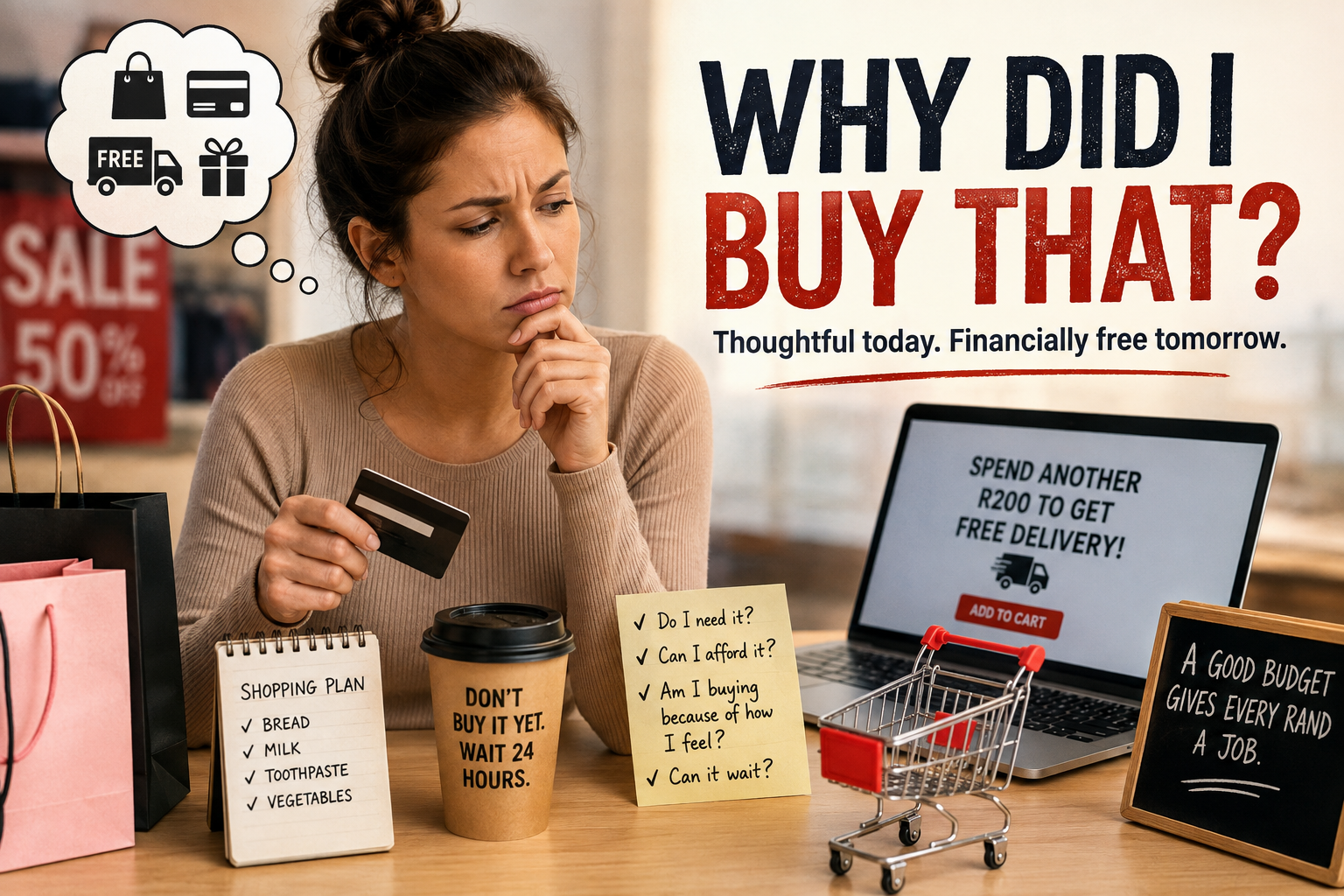
A good budget gives every rand a job. Unplanned shopping can quietly start giving that money a different job.
Why Does Buying Something Feel So Good?
There is a reason people use the expression retail therapy.
Buying something new can provide a quick emotional lift. Perhaps you’ve had a difficult week and decide
that you deserve a treat. Maybe buying a new outfit makes you feel more confident. Perhaps purchasing
something for your home gives you a sense of progress.
Shopping and spending can even give us a temporary feeling of control or power.
You want something. You choose it. You buy it. Now it’s yours.
The problem is that the emotional reward usually happens immediately, while the financial consequences
come later.
This is particularly true when we use credit.
A credit card, store account or Buy Now Pay Later (BNPL) service allows us to enjoy the purchase today
while shifting some or all of the financial impact into the future.
That separation can make it much easier to spend.
If you had to physically take R2 000 out of your wallet and hand it to someone, you might think carefully
about the purchase. Clicking a button and agreeing to several smaller future payments can feel very
different, even though you’re still spending the money.
Buy Now Can Mean Worry Later
Buy Now Pay Later services have made it possible to get products today that we might previously have had
to save for.
That convenience can be useful when carefully planned for, but it can also change the way we think about
affordability.
Imagine something costs R1 200.
If you had to pay R1 200 today, you might decide that it is too expensive and wait until you’ve saved
enough.
But if you’re offered several smaller payments, you may stop thinking of it as a R1 200 purchase.
Instead, your brain starts saying: It’s only R300 today.
The product hasn’t become cheaper. Only the timing of the payments has changed.
The remaining money still has to come from somewhere.
Those future repayments are already making claims on future income. One repayment might fit comfortably
into your budget. But what happens when there are three, four or five purchases being paid off at the
same time?
And what happens if the car needs repairs, the electricity bill is higher than expected or another
unexpected expense arrives?
Suddenly, money that you thought would be available next month has already been promised elsewhere.
Depending on the provider and agreement, missing a necessary BNPL payment can also lead to fees or other
unplanned costs, making an already tight month even more difficult.
So, when considering BNPL, don’t just ask: Can I afford today’s payment?
Ask: Can my future budget comfortably afford all the payments?
If the answer isn’t an easy yes, perhaps the purchase should wait.
Shopping Without a Plan
Shopping lists may seem old fashioned, but there is a very good reason people use them.
A list gives your shopping trip a purpose and a boundary.
You aren’t going to the supermarket to see what looks nice. You’re going there because you need bread,
milk, toothpaste and vegetables.
The same principle can apply to other types of shopping.
Before heading to the mall or opening an online store, know what you’re actually looking for and roughly
how much you’re prepared to spend.
Without a plan, we’re much more vulnerable to impulse purchases.
And we can be surprisingly good at convincing ourselves that an impulse purchase makes sense.
It’s on special. It’s only R99. I’ve wanted one for ages. I might need one eventually. This is the last
one. I deserve something nice.
None of those statements automatically make something a bad purchase.
You might genuinely deserve a treat. The product might genuinely be a bargain. You might eventually need
it.
But none of those things necessarily mean that you should buy it today.
Impulse purchases are particularly dangerous because each individual purchase can seem too small to
matter.
R50 here. R120 there. Another R80 online.
None feels disastrous.
But your monthly budget doesn’t experience these purchases individually. It experiences the total.
Ten small, harmless purchases can become one rather large budget problem.
The Free Delivery Trap
Online shopping has introduced its own clever ways of encouraging us to spend more.
You’ve found the item you want and you’re ready to pay.
Then a message appears: Spend another R200 to qualify for FREE delivery!
Nobody likes paying delivery fees. Spending money on an actual product feels much better than spending
money on having a box transported to your house.
So you start browsing again.
Perhaps you add something costing R80. You’re still short.
Then you find something else for R140.
Excellent. You’ve unlocked free delivery.
Except, have you actually saved any money?
If delivery would have cost R70 and you’ve added R220 worth of things you didn’t originally want, you’ve
spent an extra R150 in the process of trying to save R70.
That doesn’t mean free delivery offers are always bad. If you genuinely need several items, combining them
into one order can make excellent financial sense.
The important thing is to look at the total cost rather than becoming focused on avoiding a delivery fee.
Ask whether the purchase can wait until you genuinely need other items from the same supplier.
Check whether the same product is available elsewhere for less once delivery is included.
And sometimes simply pay the delivery charge.
Paying R70 for delivery can be much cheaper than spending R200 on things you didn’t need.
Don’t Buy It Yet
Being good with money doesn’t mean never having fun, never shopping and never buying things you want.
A budget isn’t supposed to punish you.
Ideally, your budget should help you decide what you can afford so that you can spend some of your money
without constantly worrying about the consequences.
The trick is making sure that you are making the decision.
Not boredom. Not a bad day. Not a flashing SALE sign. Not a countdown timer on a website. Not the promise
of free delivery. And not the temptation of paying only a small amount today.
One of the simplest ways to take back control is to introduce a little time between wanting something and
buying it.
If a purchase wasn’t planned, don’t automatically tell yourself that you can’t have it.
Instead, tell yourself: Don’t buy it yet.
Wait 24 hours.
During that time, ask yourself a few simple questions: Did I plan to buy this? Do I actually need it? Can
I comfortably afford the full cost? Am I buying this because of how I’m feeling right now? Would I still
buy it if there was no sale, reward, free delivery or BNPL option? What happens if I wait until next
month?
You may wake up the next morning and still decide that you want it. You might check your budget, realise
you can comfortably afford it and go ahead with the purchase.
That’s fine.
But you may also discover that the excitement has disappeared and you’re no longer particularly
interested.
In that case, you’ve saved yourself some money without really giving anything up.
The goal isn’t to stop shopping.
It’s to stop shopping without thinking.
Because one of the easiest ways to protect a carefully planned budget isn’t necessarily learning to say:
I can’t buy that.
Sometimes it’s simply learning to say: I don’t need to buy that today.